Product Description
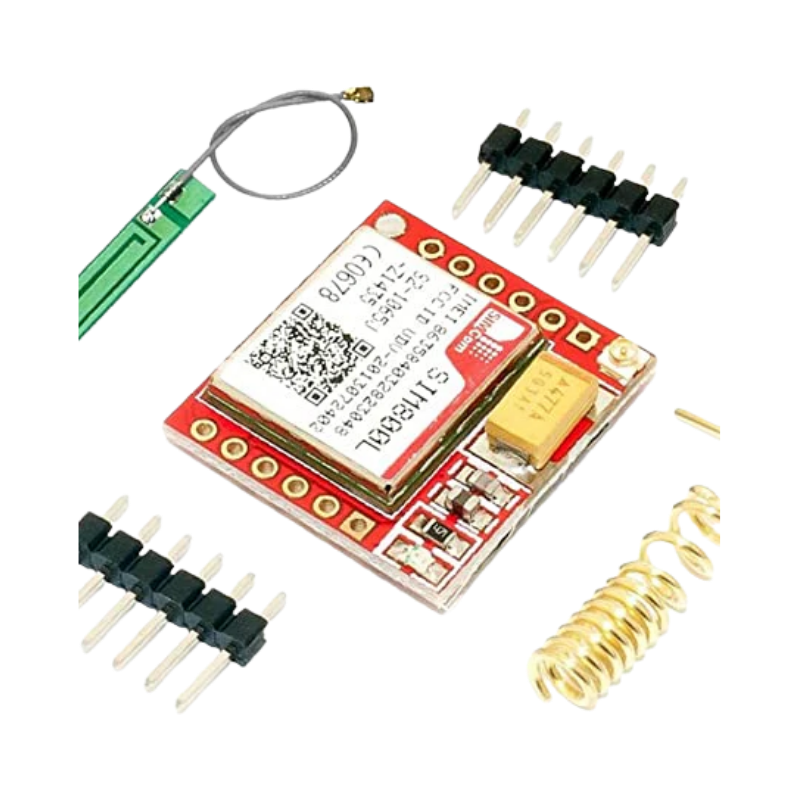
A ultra-compact cellular communication breakout board designed for remote telemetry, automated SMS notifications, and mobile IoT data synchronization in Arduino and ESP32 systems. Powered by the reliable SIM800L quad-band GSM/GPRS engine, this module connects tiny microcontrollers directly to standard cellular networks for transmitting text messages, making voice calls, or transferring data payloads via GPRS. It features a pop-out Micro SIM card slot on the reverse side and utilizes standard AT serial commands for complete system configuration. Because it draws brief, high-current spikes up to 2A during network registration, it is the ideal cellular bridge for remote environmental stations, smart security systems, and wireless asset-tracking hardware.
Pinout / Layout Connections
The module routes its asynchronous serial lines and power connections via a standard dual-row pin configuration:
VCC Pin: Main power supply input. Requires a stable DC +3.4V to +4.4V (Optimal: 4.0V). Do not connect directly to 5V power rails without an appropriate step-down buck converter or high-current Li-Ion cell.
GND Pin: Common system ground reference. Must be linked firmly to both the external power supply and the microcontroller ground.
TXD Pin: Serial Data Output. Transmits AT responses or text data to the host microcontroller’s RX line.
RXD Pin: Serial Data Input. Receives AT commands from the host microcontroller. Requires a inline resistor or level shifter if connecting to a 5V Arduino TX pin.
RST (Reset) Pin: Hardware hard-reset pin. Forcefully reboots the cellular engine when pulled low momentarily.
NET Pin: Antenna terminal connection pad. Connects directly to the included helical wire antenna or external IPEX patch line.

Applications
Remote Security Alerts: Perfect for building standalone anti-theft alarms that immediately text or call a user when motion or localized sensors trip.
Off-Grid Telemetry Hubs: Excellent for transmitting sensory parameters from agricultural monitoring arrays back to centralized databases using standard GPRS data streams.
Automated Asset Tracking: Ideal for pairing with GPS receiver modules to construct compact vehicle tracking nodes that update location data over cellular networks.
Compatibility
The SIM800L functions as a hardware-level cellular transceiver that communicates over simple serial lines, ensuring compatibility across development platforms:
Arduino Board Series (Uno, Nano, Mega) using standard SoftwareSerial configurations (with a 5V-to-3.3V resistor voltage divider on the RXD pin).
ESP32 and ESP8266 development boards (Fully compatible with native 3.3V UART signal channels).
Raspberry Pi and Raspberry Pi Pico modules using direct Python serial interfaces.
Standard Micro-SIM Cards from local networks (Vodafone, Orange, Etisalat, WE).
Technical Specifications
| Parameter | Value / Specification |
| Core Cellular Chipset | SIMCom SIM800L Quad-Band GSM/GPRS |
| Supported Network Bands | Quad-band: 850 MHz, 900 MHz, 1800 MHz, 1900 MHz |
| Core Input Supply Voltage | DC 3.4 V to 4.4 V (Requires minimum 2A peak current capability) |
| Logic Communication Level | 2.8V TTL Serial (Safe for 3.3V systems; requires level shifts for 5V) |
| Default UART Baud Rate | Auto-baud matching by default (Commonly set at 9600 bps or 115200 bps) |
| GPRS Data Speed | GPRS Slot Class 12 (Max 85.6 kbps download/upload) |
| SIM Card Socket Interface | Micro SIM Slot (Bottom side layout) |
| Network Status Indicator | Onboard LED (Flashes rapidly when searching, blinks slowly every 3 seconds with active network sync) |
What’s in the Box
1 x SIM800L GPRS GSM Breakout Board Module.
1 x Helical Spring Wire Antenna.
1 x 7-Pin Straight Male Breakaway Header.
Available now from Pro Tronix with guaranteed quality and fast delivery nationwide.




 LED
LED

 LCD
LCD