


 LED
LED

 LCD
LCD




Product Description
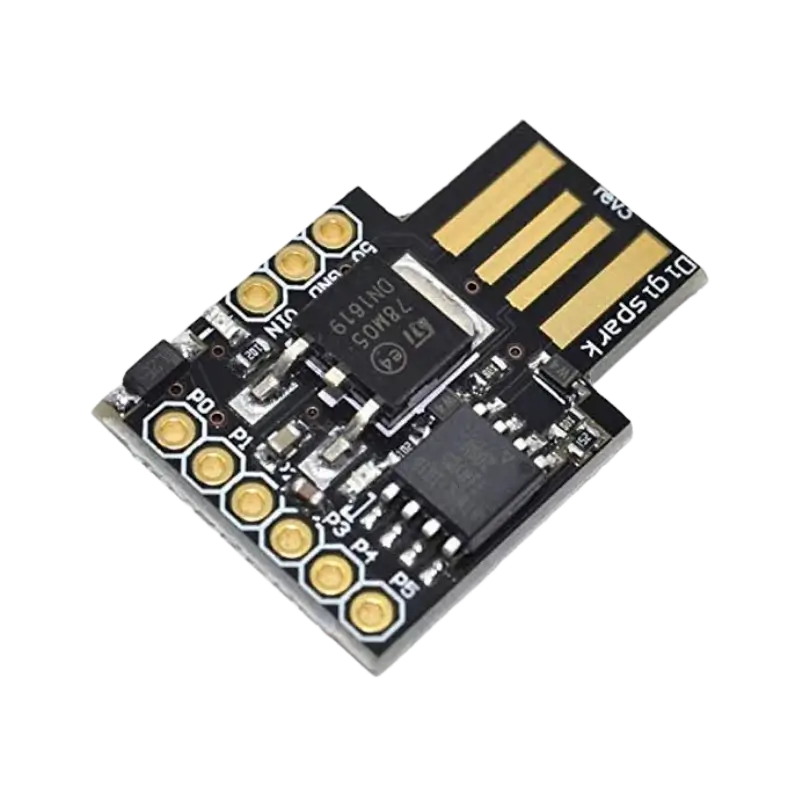
An ultra-miniature, low-cost microcontroller development board designed for space-constrained DIY electronics, wearwearable computing, and simple automation routines. Powered by the Microchip ATtiny85 8-bit AVR processor, this compact module (commonly referred to as the Digispark layout) packs robust processing capabilities into a footprint barely larger than a postage stamp. It comes pre-programmed with the Micronucleus USB bootloader, enabling direct programming and power delivery through its onboard Micro-USB connector without requiring an external hardware programmer. Outfitted with 6 versatile general-purpose I/O pins, hardware PWM channels, and an onboard 5V regulator, it serves as the ultimate pocket-sized bridge for small-scale robotic nodes, smart USB keystroke emulators, and custom hardware interface prototyping.
Pinout / Layout Connections
The module breaks out its inputs, outputs, and power lines via two standard 2.54mm pitch terminal banks:
Micro-USB Port: Primary programming gateway and 5V power input.
VIN Pin: External unregulated DC power input. Accepts DC +7V to +12V (smoothly stepped down by the onboard 5V regulator).
5V Pin: Regulated +5V output (when powered via VIN) or +5V input (when bypassing the regulator).
GND Pin: Common system ground (0V) reference.
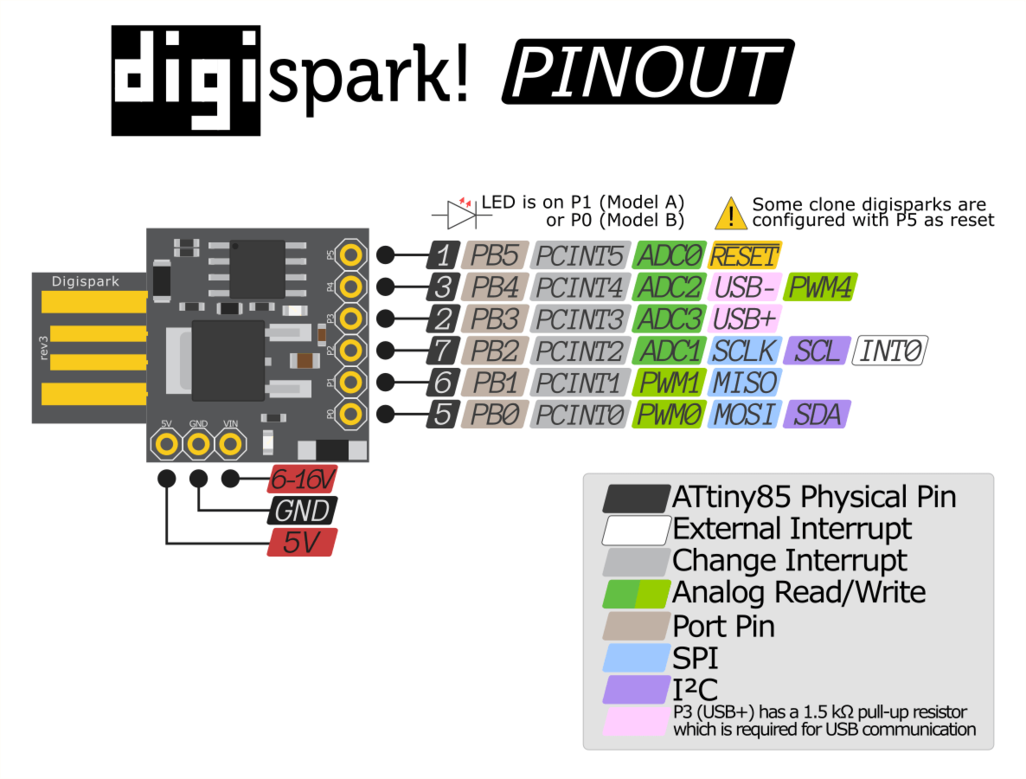
P0 to P5 (GPIO Pins): 6 programmable digital I/O pins.
P0: I2C SDA, Physical PWM, or Digital I/O.
P1: I2C SCL, Physical PWM, Built-in LED (on most boards), or Digital I/O.
P2: Analog Input (ADC1) or Digital I/O.
P3: Analog Input (ADC3), Digital I/O, or USB+ (Used during USB communication).
P4: Analog Input (ADC2), Physical PWM, Digital I/O, or USB- (Used during USB communication).
P5: Analog Input (ADC0), Digital I/O, or physical Reset pin.
Applications
Compact Wearables & Cosplay: Perfect for integrating flashing LEDs, small servo behaviors, or sensor triggers into tight costumes and custom jewelry.
USB Human Interface Devices (HID): Excellent for constructing custom macro pads, mechanical shortcut keypads, or automated system maintenance tools.
Distributed Smart Nodes: Ideal for low-complexity hardware tasks such as reading an analog temperature probe and directly cycling an output relay.
Compatibility
The ATtiny85 USB module interfaces smoothly with standard desktop programming environments:
Arduino IDE (Compatible by adding the Digistump board manager URL and installing the Micronucleus drivers).
Micronucleus Bootloader Command Line Tools (Compatible across Windows, macOS, and Linux platforms).
Standard 5V/3.3V Logic Systems (Internal hardware operates at 5V; easily interfaceable with common sensors).
Technical Specifications
| Parameter | Value / Specification |
| Processor Core | 8-bit Microchip AVR ATtiny85 Microcontroller |
| Flash Memory Space | 8 KB (approx. 6 KB available after bootloader allocation) |
| SRAM / EEPROM | 512 Bytes SRAM / 512 Bytes EEPROM |
| Clock Speed | Internal Oscillator running at 8 MHz or 16.5 MHz (via software PLL) |
| Onboard Voltage Regulator | 5V 500mA LDO Regulator |
| Hardware Interfaces | I2C (USI), SPI (USI), 4-Channel 10-bit ADC, 3-Channel PWM |
| Hardware Indicators | Onboard Power LED and Test/Status LED (Typically linked to pin P1) |