


 LED
LED

 LCD
LCD




Product Description
The Pulse Heart Rate Sensor is a plug-and-play, plug-in-and-read biometric sensor designed for hobbyists, students, and makers. It uses photo plethysmography (PPG)—shining a green LED light into your fingertip or earlobe and measuring the tiny changes in light reflection caused by the blood pulsing through your capillaries with each heartbeat.
This sensor integrates an optical sensor, an amplification IC, and a noise-elimination circuit directly onto a tiny, circular board. The analog output signal is incredibly easy to interface, serving as a live wave representation of your pulse that microcontrollers can parse to calculate beats per minute (BPM) in real time.
⚠️ Important Disclaimer: This sensor is designed strictly for prototyping, educational, and hobbyist projects. It is not a certified medical-grade device and must never be used for diagnostic purposes, clinical monitoring, or life-safety applications.
Pinout / Layout Connections
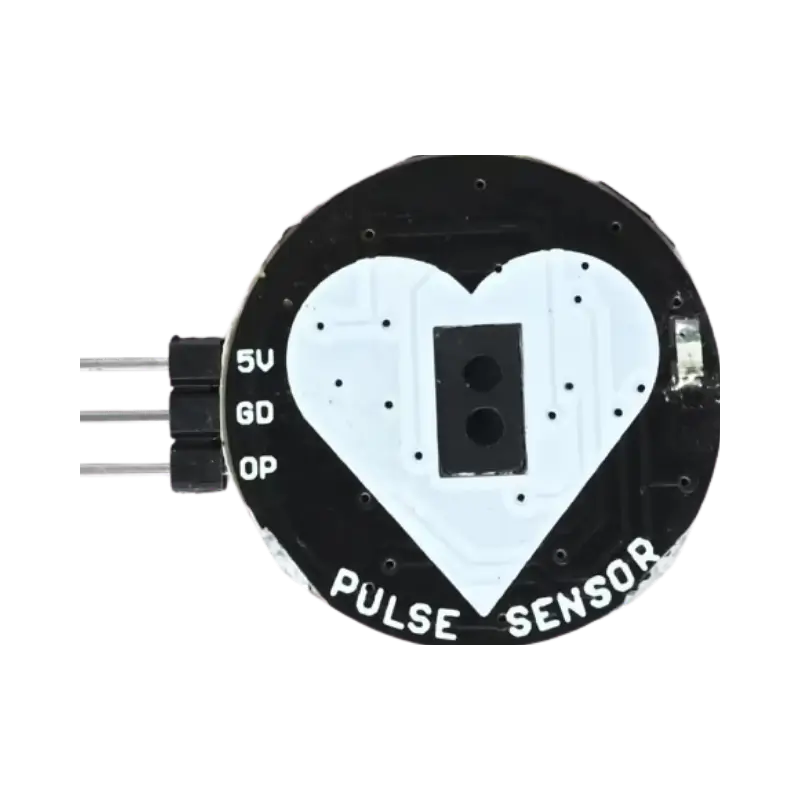
The module breaks out to a standard 3-pin connector with a flexible, high-quality cable:
S / OUT (Signal Wire – Purple or Yellow): Analog output signal. Connect to any Analog Input Pin on your microcontroller (e.g., A0 on an Arduino Uno).
+ (VCC Wire – Red): Connect to a $+3.3\text{V}$ or $+5\text{V}$ power source from your microcontroller.
– (GND Wire – Black): Connect to the common system Ground (GND).
Applications
Wearable Fitness Devices: Prototyping basic smartwatches, biometric armbands, or health-tracking wearables.
Interactive Art & Gaming: Syncing physical game environments, lighting systems, or audio feedback directly to a user’s real-time heartbeat.
Biometric Authentication Experiments: Designing educational projects exploring unique pulse wave characteristics.
Technical Specifications
Operating Voltage (V): 3 to 5 Sensor Diameter 30 mm Operating Current (mA): 4 Shipping Weight 0.03 kg Shipping Dimensions 5 × 3 × 1 cm