


 LED
LED

 LCD
LCD




Product Description
The ADXL345 is a small, thin, ultra-low power 3-axis accelerometer with high-resolution (13-bit) measurement up to +/- 16g. This digital sensor is designed to measure both dynamic acceleration resulting from motion or shock, as well as static acceleration, such as gravity, which allows it to double as a highly accurate tilt sensor.
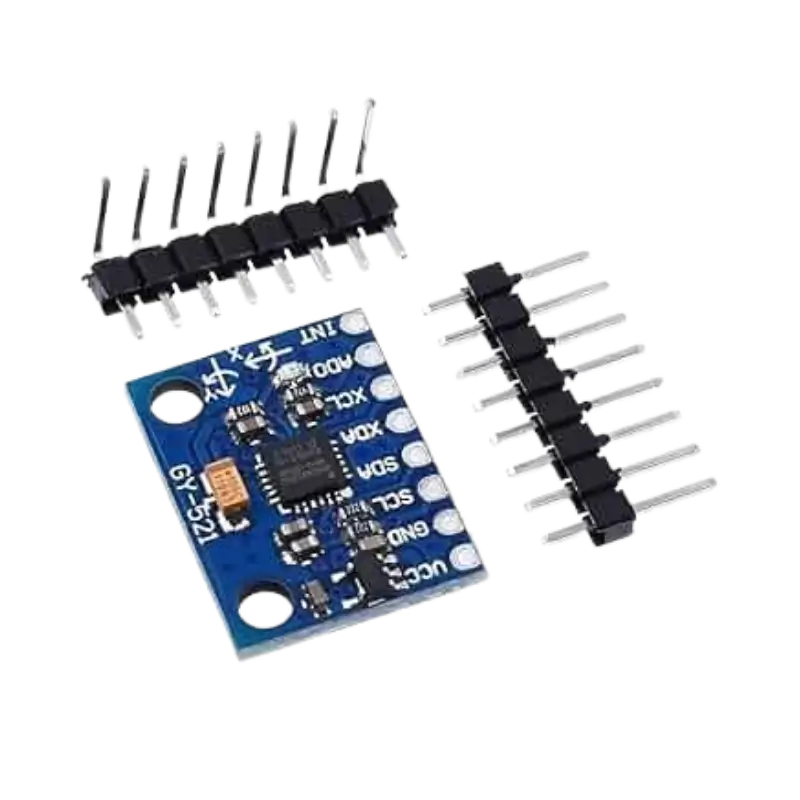
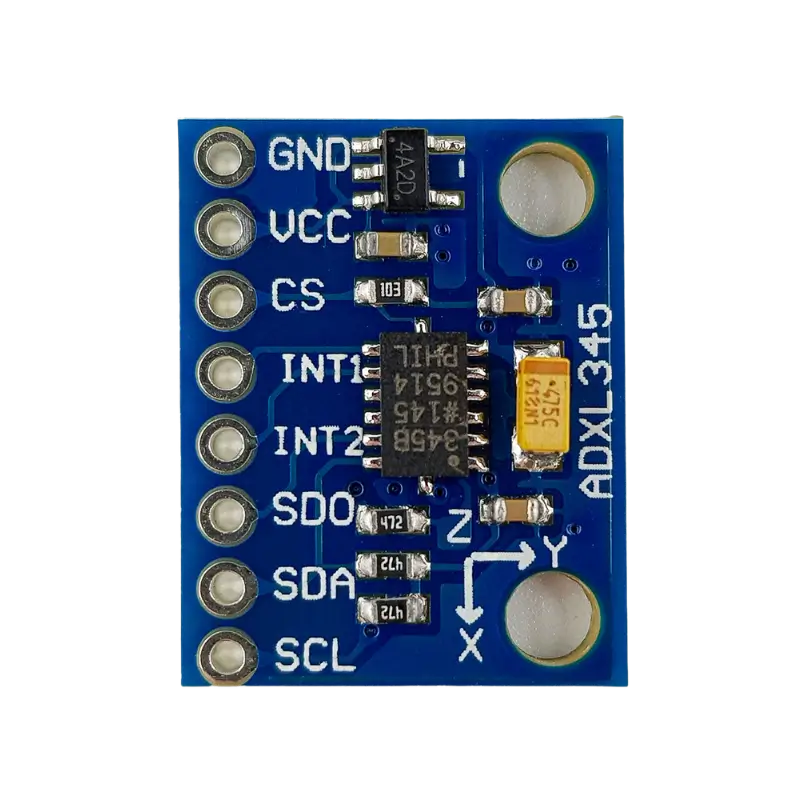
Mounted on the popular GY-291 breakout board, this module features an onboard 3.3V low-dropout (LDO) voltage regulator and level-shifting components, making it fully compatible with both 3.3V and 5V microcontrollers. With support for both standard I2C and SPI digital communication protocols, it integrates effortlessly into robotics, aerospace, and motion-tracking projects. It is also the industry-standard sensor used for “Input Shaping” resonance testing in modern high-speed 3D printers running Klipper firmware.
⚠️ Configuration Note: For I2C communication, the module’s default I2C address is 0x53 (when the SDO pin is grounded or left floating). If you tie the SDO pin to 3.3V, the I2C address changes to 0x1D. Always double-check your code’s address configuration if your microcontroller fails to establish a connection.
Pinout / Layout Connections
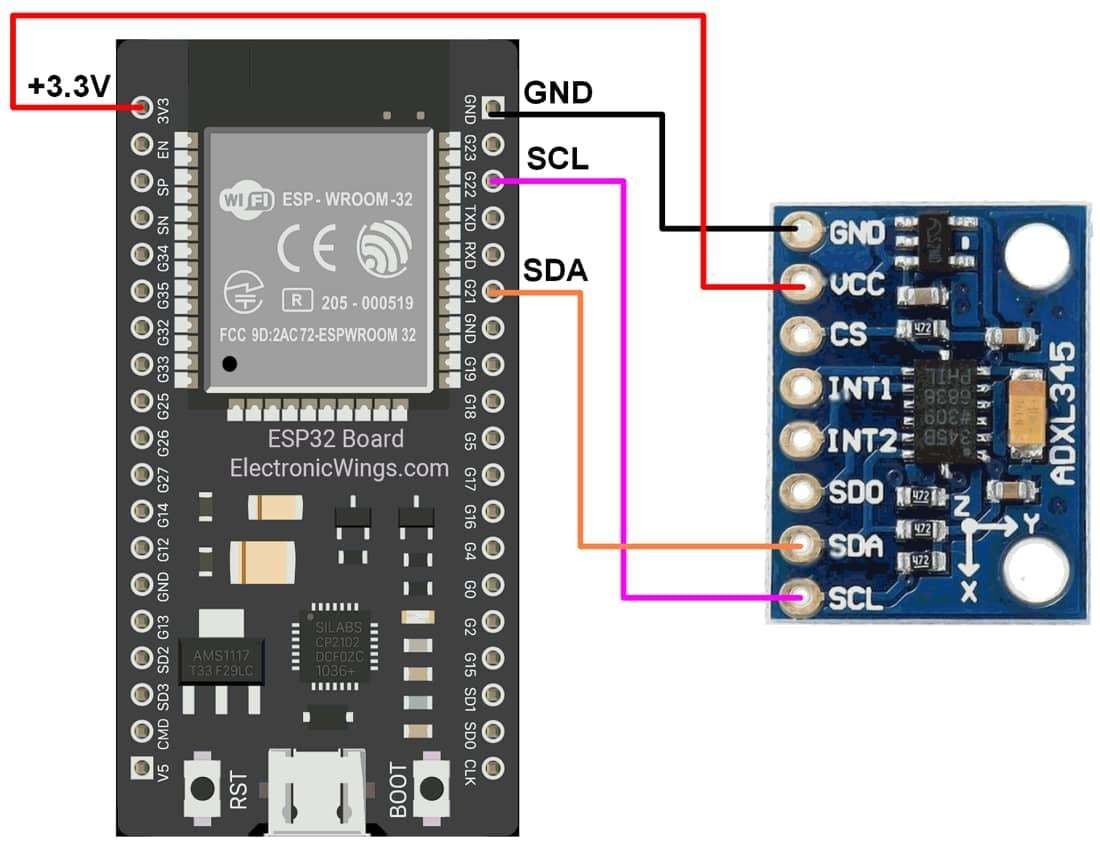
The module breaks out a double-row friendly 8-pin interface supporting both I2C and SPI modes:
-
VCC: Power supply input. Connect to 3V to 5V DC.
-
GND: Connect to your system’s common ground (0V).
-
CS: Chip Select pin. Pull High (to VCC) for I2C mode. Pull Low for SPI mode.
-
INT1: Interrupt 1 output. Can trigger on events like single tap, double tap, or free-fall.
-
INT2: Interrupt 2 output. Secondary customizable interrupt pin.
-
SDO: Serial Data Out / I2C Address select pin.
-
SDA / SDI: I2C Serial Data / SPI Serial Data Input line.
-
SCL / SCLK: I2C Serial Clock / SPI Serial Clock line.
Applications
-
3D Printer Input Shaping: Eliminating surface ringing and ghosting on high-speed 3D printers running Klipper firmware.
-
Gesture & Tilt Sensing: Designing smart controllers, hand-held gaming devices, and stabilization platforms.
-
Free-Fall & Impact Detection: Protecting sensitive hard drives or triggering safety switches when a device falls or experiences a sudden impact.
-
Robotic Self-Balancing: Assisting two-wheeled or bipedal robots in maintaining upright balance.
Technical Specifications
| Parameter | Value / Specification |
| Sensing IC | Analog Devices ADXL345 |
| Measurement Axes | 3-Axis (X, Y, Z) |
| Operating Voltage | 3.0V to 5.0V DC (onboard 3.3V LDO regulator) |
| Interfaces | I2C (up to 400 kHz) and SPI (3-wire or 4-wire, up to 5 MHz) |
| Resolution | 10-bit to 13-bit (User selectable; up to 4mg/LSB) |
| Measurement Range | Adjustable: +/- 2g, +/- 4g, +/- 8g, or +/- 16g |
| Power Consumption | Ultra-low: 30 microamps in measurement mode, 0.1 microamps in standby |
| Onboard Features | Tap, double-tap, activity, inactivity, and free-fall detection |
| Dimensions | 20mm x 15mm |
What’s in the Box
-
1 x ADXL345 3-Axis Accelerometer Module.
-
1 x 8-Pin Straight Male Header Strip.